

Why "just get a degree" is no longer enough
If you are a student or a fresher in India right now, you have probably felt it: a degree opens the door, but it does not guarantee the job anymore. The India Skills Report 2026, a joint study by ETS, CII, AICTE and AIU covering responses from over 1 lakh candidates and 1,000+ organisations, shows India's national employability score climbed to 56.35% in 2026, up from 54.81% the year before.
That is genuine progress. But flip the number around, and nearly 44 out of every 100 candidates are still not considered job-ready by employers. That gap is not about intelligence or effort. It comes down to skills: the ones companies are actively hiring for versus the ones most students are still building.
So the real question this year is not "should I upskill?" It is "which skill deserves my next six months?"
What Indian employers are actually hiring for
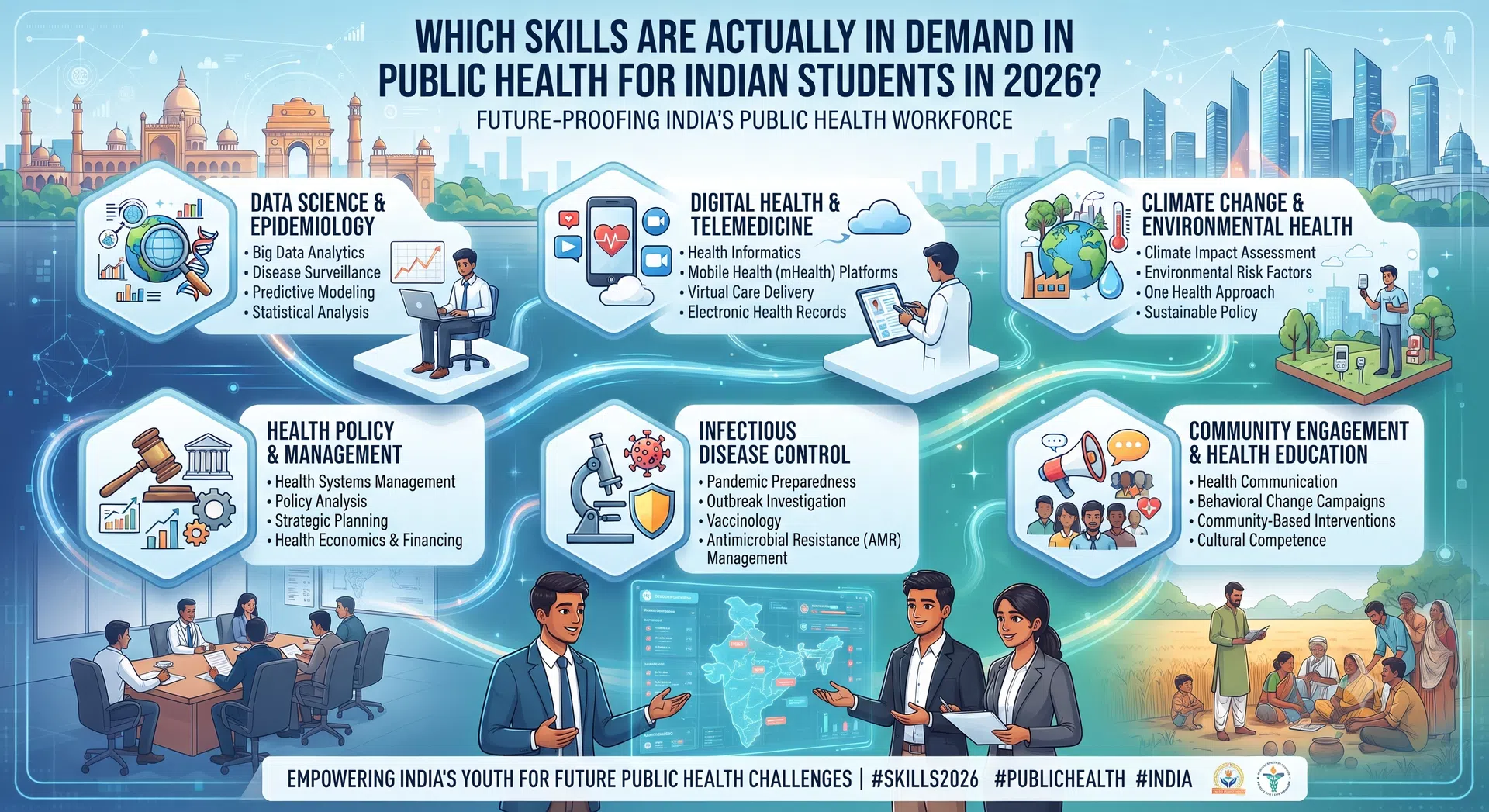
The India Skills Report 2026 identifies four skill areas dominating hiring conversations across Indian industry right now:
Artificial intelligence
Data analytics
Cloud computing
Cybersecurity
LinkedIn's Skills on the Rise 2026 report for India arrives at a closely related picture from a different data set, hiring and job-posting activity rather than employer surveys, naming five fastest-growing skill stacks: AI & Automation, Data & Analytics, IT & Cybersecurity, Business & Growth, and People & Leadership. The overlap between a campus-and-employer survey and a hiring-data report is worth noting: it suggests these are not fads confined to one corner of the job market.
Recruiters can't find the people they need
LinkedIn's report also found that 74% of Indian recruiters are struggling to find candidates with the right skills, even though the roles themselves are open. Vacancies exist; qualified applicants often don't.
The gap is sharpest in AI. India holds roughly 16% of the world's AI talent pool, but according to Edstellar's 2026 hiring analysis, the country has over 290,000 open AI/ML roles with a talent gap of around 51%. Roughly one qualified candidate is available for every two AI-related openings.
For anyone deciding what to learn next, that shortfall is worth treating as an opportunity rather than just a statistic.
Choosing a skill: three things to check
Most students pick a skill because it's trending online, not because it fits their background or stage. Before committing time to anything, weigh three factors:
Demand: Does the skill show up across multiple independent hiring reports, not just one viral post?
Fit: Does it match your current base, a commerce background, an engineering degree, or no technical background at all?
Depth: Are you prepared to go beyond a weekend certificate and actually build something with it?
Jobaaj Learnings' skills breakdown, published on 19 August 2026, applies this kind of filter to shortlist 10 online-learnable skills for 2026, each mapped against real salary ranges, difficulty level, and who it suits, screened for being learnable online, backed by real hiring demand, and realistic for a fresher to start. Generative AI & Prompt Engineering tops that list, which lines up with how central AI has become in both the India Skills Report and LinkedIn's findings, though the real value of a breakdown like that lies in comparing all 10 skills against your own starting point, not in any single entry.
What this means for your next move
If you're still deciding what to add to your resume this year, treat it as a research decision, not a trend hunt:
Start from the four employer-confirmed areas: AI, data analytics, cloud computing, cybersecurity. These are baseline expectations in a growing number of hiring pipelines now, not niche add-ons.
Don't ignore the "soft" stack: Business & Growth and People & Leadership are among LinkedIn's fastest-growing skill areas too. Technical skills get you shortlisted; these often decide who gets promoted.
Match the skill to your stage: a first-year engineering student, a final-year commerce graduate, and a working professional switching careers shouldn't learn the same skill the same way. Check difficulty level and prerequisites before you commit.
Go deep, not wide: with a 51% talent gap in AI/ML roles alone, employers aren't short of people who know the buzzwords. They're short of people who can apply a skill to a real problem.
The bottom line
India's employability score is improving, but slowly, and the gains are concentrated among students learning the right things in the right way. AI, data, cloud and cybersecurity aren't passing trends for 2026, they're the areas employers are actively struggling to hire for. The smartest move this year is to stop chasing whatever's loudest online, pick one in-demand skill, understand what it actually pays and requires, and commit to learning it properly.