
Why "just learn a skill" isn't good enough advice anymore
Every year, students are told to "upskill" without much clarity on what that actually means in practice. Do you learn Python or PowerPoint? Cloud or content writing? In 2026, guessing your way through this decision is a costly mistake, because the gap between what students are learning and what companies actually need has become measurable, and it's wide.
The good news is that you no longer have to guess. Two major reports released for 2026, the India Skills Report and LinkedIn's Skills on the Rise report, have laid out exactly where Indian employers are struggling to find talent. The figures below are drawn from those two reports and from Edstellar's 2026 hiring analysis, as summarised in Jobaajlearnings' "Top 10 In-Demand Skills to Learn Online in 2026." If you're a student or a fresher trying to decide where to invest your next six months of learning, this data is about as close to a roadmap as you'll get.
The employability number every student should know
According to the India Skills Report 2026, a joint study by ETS, CII, AICTE and AIU that surveyed over 1 lakh candidates and 1,000+ organisations, India's national employability score rose to 56.35% in 2026, up from 54.81% the year before.
That's a genuinely encouraging sign. It means more Indian graduates are considered job-ready by employers than before. But flip that number around and it also means nearly 44% of candidates are still seen as not employable for the roles available to them. The difference between the two groups usually comes down to one thing: whether their skillset matches what industry actually needs right now, not what was in demand five years ago.
The four skill areas Indian industry is short on
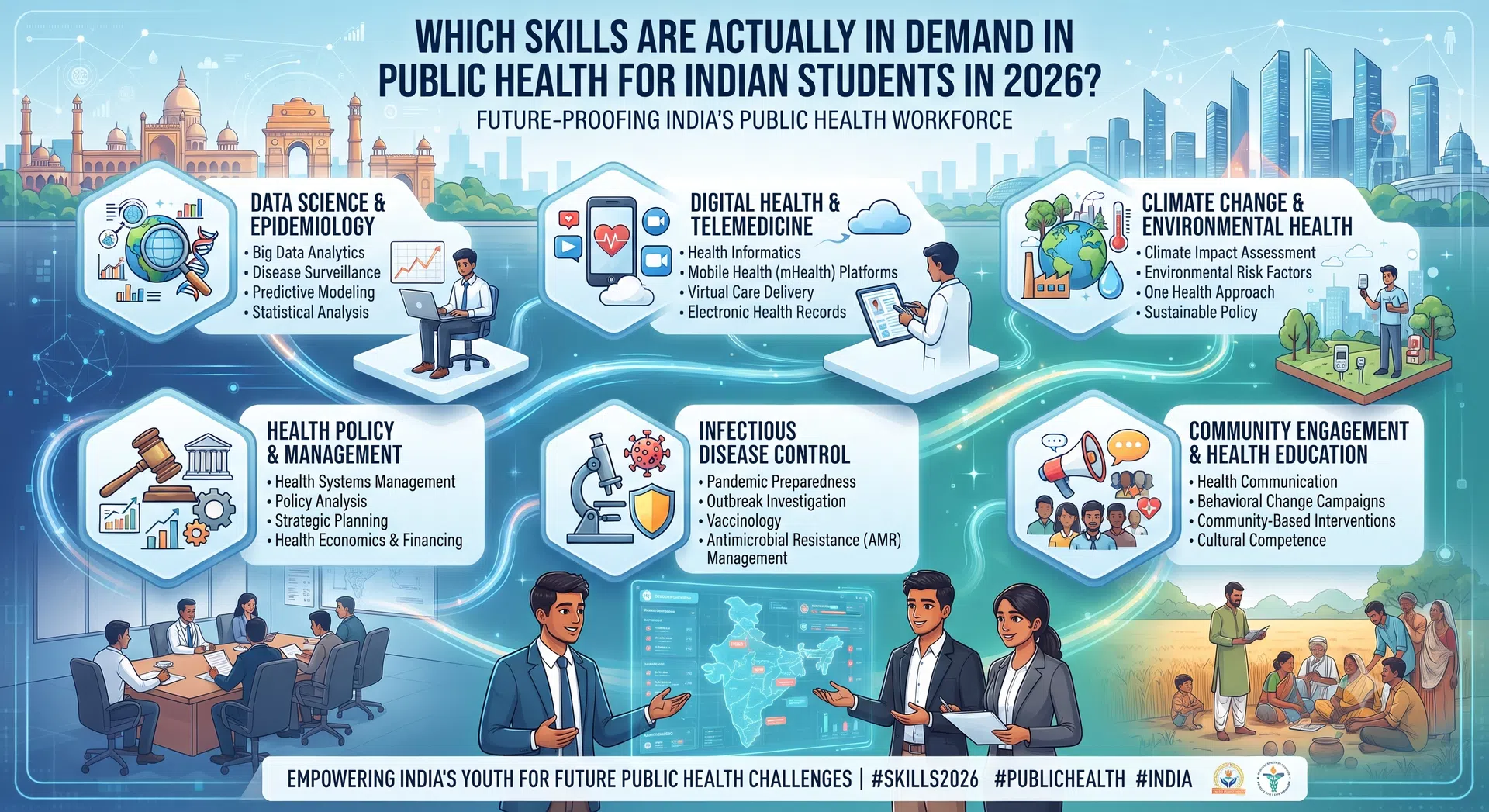
The same report identifies AI, data analytics, cloud computing and cybersecurity as the most in-demand skill areas across Indian industry today. These aren't niche, futuristic skills anymore, they're the baseline expectations in a growing number of hiring processes, from IT services to banking to manufacturing.
LinkedIn's Skills on the Rise 2026 report for India backs this up with more granularity, identifying five fastest-growing skill stacks:
AI & Automation - tools and workflows that use AI to speed up or replace manual tasks
Data & Analytics - reading, interpreting and acting on data, not just collecting it
IT & Cybersecurity - protecting digital infrastructure as more business moves online
Business & Growth - skills tied to revenue, marketing and scaling operations
People & Leadership - the human skills needed to manage teams and projects well
Notice that this list isn't purely technical. Two of the five fastest-growing stacks are about how you work with people and grow a business, not just what software you know. That's an important correction to the assumption that "in-demand" only means "coding-related."
Why companies can't find the people they need
Here's the part that should really change how you think about your learning plan: 74% of Indian recruiters report struggling to find candidates with the right skills, even though job openings exist, according to LinkedIn's report. This isn't a hiring freeze or a lack of jobs. It's a mismatch between the skills employers need and the skills most job seekers currently have.
Nowhere is this gap clearer than in AI. India holds about 16% of the world's AI talent pool, which sounds substantial until you look at the demand side. There are over 290,000 open AI/ML roles in India right now, with a talent gap of roughly 51%, according to Edstellar's 2026 hiring analysis. In plain terms, for every two AI-related roles open in India, only about one qualified candidate is available to fill it.
If you're a student weighing whether to spend your time learning AI and machine learning fundamentals versus something more generic, this is the kind of number that should tip the decision.
A note on these numbers: these statistics are cited as reported by the India Skills Report 2026, LinkedIn's Skills on the Rise 2026 report, and Edstellar's 2026 hiring analysis, via Jobaajlearnings' summary of those reports. We have not been able to independently verify them against the original primary reports, so treat them as reported figures rather than independently confirmed ones.
What this actually means for your learning plan
You don't need to become a data scientist or a cybersecurity expert overnight, and honestly, trying to learn all five in-demand areas at once usually backfires. What works better is picking one or two areas that align with your current field of study and building depth there.
The suggestions below are not drawn from either report, they're our own practical read on how a student might apply this data, so treat them as a starting point for your own research rather than an industry-verified plan:
Engineering or CS students could consider prioritising AI/ML and cloud computing, since these connect most directly to existing coursework and, per the data above, have the widest hiring gap.
Commerce and business students may be well placed to lean into Data & Analytics or Business & Growth, both of which reward people who can already read financial or market data.
Anyone in a people-facing role, from HR to operations, may not want to ignore People & Leadership skills. LinkedIn's data shows this stack is growing just as fast as the technical ones.
If you're unsure where to start, cybersecurity and data analytics tend to have lower entry barriers than deep AI/ML roles and can be a practical first step.
The real takeaway
The India Skills Report's rising employability score shows the system is moving in the right direction. But a 56.35% employability rate also means the gap is still large enough that being deliberate about what you learn gives you a real edge over someone who is just collecting certificates.
Before enrolling in your next online course, ask yourself one question: does this skill show up in the reports employers are actually using to hire? If the answer is AI, data analytics, cloud or cybersecurity, you're already on the right track. If it isn't, it might be worth checking whether that course is solving a real hiring gap or just following a trend.