

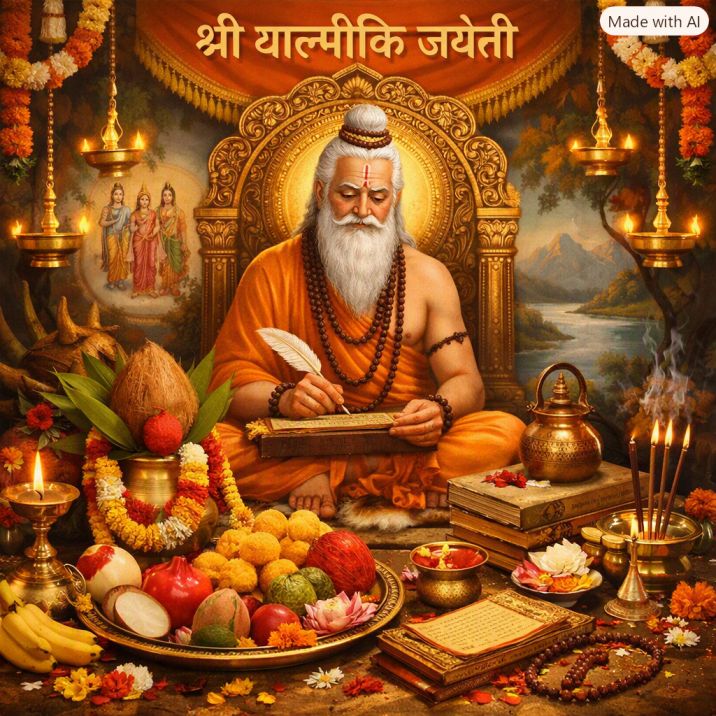
Celebrating the Adi Kavi and the Birth of the Ramayana
Introduction to Valmiki Jayanti
Valmiki Jayanti is a revered annual cultural and spiritual festival dedicated to the birth anniversary of Maharishi Valmiki, honored universally as the Adi Kavi (the First Poet) of Sanskrit literature. Celebrated on the full moon day (Purnima) in the Hindu month of Ashwin (coinciding with Sharad Purnima), this auspicious day commemorates the sage who penned the immortal epic, the Ramayana. Across India, particularly in northern and southern states, Valmiki Jayanti is observed with grand processions, recitations of verses from the Ramayana, community prayers, and cultural programs that honor the profound literary and moral heritage left behind by the sage.
From Ratnakara to Maharishi Valmiki: The Transformation
The life story of Maharishi Valmiki stands as one of the most powerful narratives of redemption, spiritual awakening, and transformation in Hindu lore.
The Early Life: According to sacred legends, before attaining spiritual enlightenment, Valmiki was known as Ratnakara, a highway robber who lived by plundering travelers to support his family.
The Turning Point: A chance encounter with the divine sage Narada led Ratnakara to a profound realization. When asked if his family would share the karmic burden of his sins, Ratnakara discovered they would not. Struck by this truth, he engaged in deep, unyielding penance (tapasya).
Birth of the Sage: So absorbed did he become in meditation that anthills (valmika in Sanskrit) grew around his body. Emerging purified from this deep meditative state, he was blessed by Brahma and named Valmiki, transforming from a sinner into a realized seer.
The Creation of the Ramayana: The First Sloka
Maharishi Valmiki holds the undisputed title of Adi Kavi because he authored the Ramayana, establishing the benchmark for classical Sanskrit poetry and epic storytelling.
The Inspiration: The birth of epic poetry began with a poignant moment of empathy. Witnessing a hunter strike down one of a pair of mating birds (krauncha), an involuntary cry of grief burst forth from Valmiki's lips in a perfectly metered poetic verse (sloka).
The Divine Command: Prompted by Lord Brahma, Valmiki utilized this very meter to compose the life story of Lord Rama, detailing his righteousness, trials, and adherence to dharma. The Ramayana became not merely a literary text, but an eternal guide on ethics, duty, and human relationships.
Rituals, Celebrations, and Community Devotion
Valmiki Jayanti is celebrated with deep reverence, community engagement, and spiritual gratitude:
Shobha Yatras (Processions): Vibrant processions carrying decorated portraits and statues of Maharishi Valmiki wind through city streets, accompanied by devotional songs, traditional instruments, and chants praising the Ramayana.
Temple Gatherings: Devotees gather at Valmiki temples to offer floral tributes, light lamps, and listen to spiritual discourses detailing the teachings of the sage.
Akhand Ramayan Path: Many communities organize continuous, uninterrupted readings (Akhand Path) of the Ramayana from start to finish, filling homes and temples with uplifting spiritual vibrations.
The Enduring Legacy of Maharishi Valmiki
Valmiki Jayanti is much more than a historical commemoration; it is a celebration of the capacity for human redemption and the supreme power of righteous literature. Maharishi Valmiki proved that one's past does not dictate their future, and through wisdom, devotion, and creative expression, an individual can elevate society for generations. As the verses of the Ramayana continue to echo across the world, Valmiki’s timeless message of truth, duty, and love remains eternally relevant.