

Nuakhai Festival of Odisha: Significance, Rituals, and Cultural Heritage
The Nuakhai festival of Odisha stands as one of the most vibrant, emotionally resonant, and culturally significant agrarian celebrations in eastern India. Celebrated primarily in Western Odisha and neighboring regions, this ancient harvest festival marks the welcoming of the new rice season. Far beyond a mere ritual, Nuakhai embodies a profound philosophy of gratitude, communal harmony, social reconciliation, and reverence for nature. As a powerful symbol of Odia heritage, Nuakhai bridges generations, drawing millions of people together to celebrate the hard work of farmers and the bounty of the earth.
The Etymological and Agrarian Roots
To understand the essence of Nuakhai, one must look closely at its linguistic roots. The term is a combination of two Odia words: Nua, meaning new, and Khai, meaning to eat. Essentially, it signifies the consumption of newly harvested paddy crops after offering them to the presiding deities.
Traditionally observed on the day following the Ganesh Chaturthi festival in the lunar month of Bhadrapada (August–September), Nuakhai coincides with a critical juncture in the agricultural calendar. By this time of the year, the paddy fields have turned lush and green, yielding their first golden grains. Farmers and rural communities celebrate this agricultural milestone to express their heartfelt gratitude to Mother Nature, ancestral deities, and agricultural tools that sustain rural livelihoods.
Sacred Rituals and the Core Observances
The celebration of Nuakhai is governed by a meticulous sequence of spiritual and social rituals, often calculated and declared by traditional astrologers and priests (Jhani or Pujari) based on auspicious planetary alignments.
Lagna (Auspicious Time): Every year, the precise moment for partaking in the new rice—known as Lagna—is determined collectively. Families across towns and villages synchronize their watches to consume the sanctified food at this exact window.
Nabanna Offering: Before anyone touches the harvest, the freshly harvested rice (known as Nabanna) is meticulously prepared and offered first to the primary village deity, such as Samaleswari, Pataneswari, or Sureswari, depending on the district.
Household Consecration: Once the divine offering is complete, individual households worship their household deities, ancestors, and farming implements. The newly harvested rice is mixed with milk, curd, jaggery, and country sugar to create a sacred delicacy shared among all family members.
Nuakhai Juhar: A Unique Tradition of Reconciliation
Perhaps the most defining social aspect of the Nuakhai festival is Nuakhai Juhar. This ritual serves as an institutionalized mechanism for social healing, forgiveness, and community bonding.
As soon as the sacred meal is consumed, younger members of the community bow down to touch the feet of their elders, seeking blessings for health, prosperity, and longevity. Following this, social hierarchies and past grievances are temporarily set aside. Friends, neighbors, and even estranged acquaintances embrace one another, exchange greetings of "Nuakhai Juhar," and resolve mutual conflicts. This powerful tradition of social reconciliation fosters an extraordinary environment of peace, unity, and mutual respect across Western Odisha.
Cultural Celebrations and Folk Art Expression
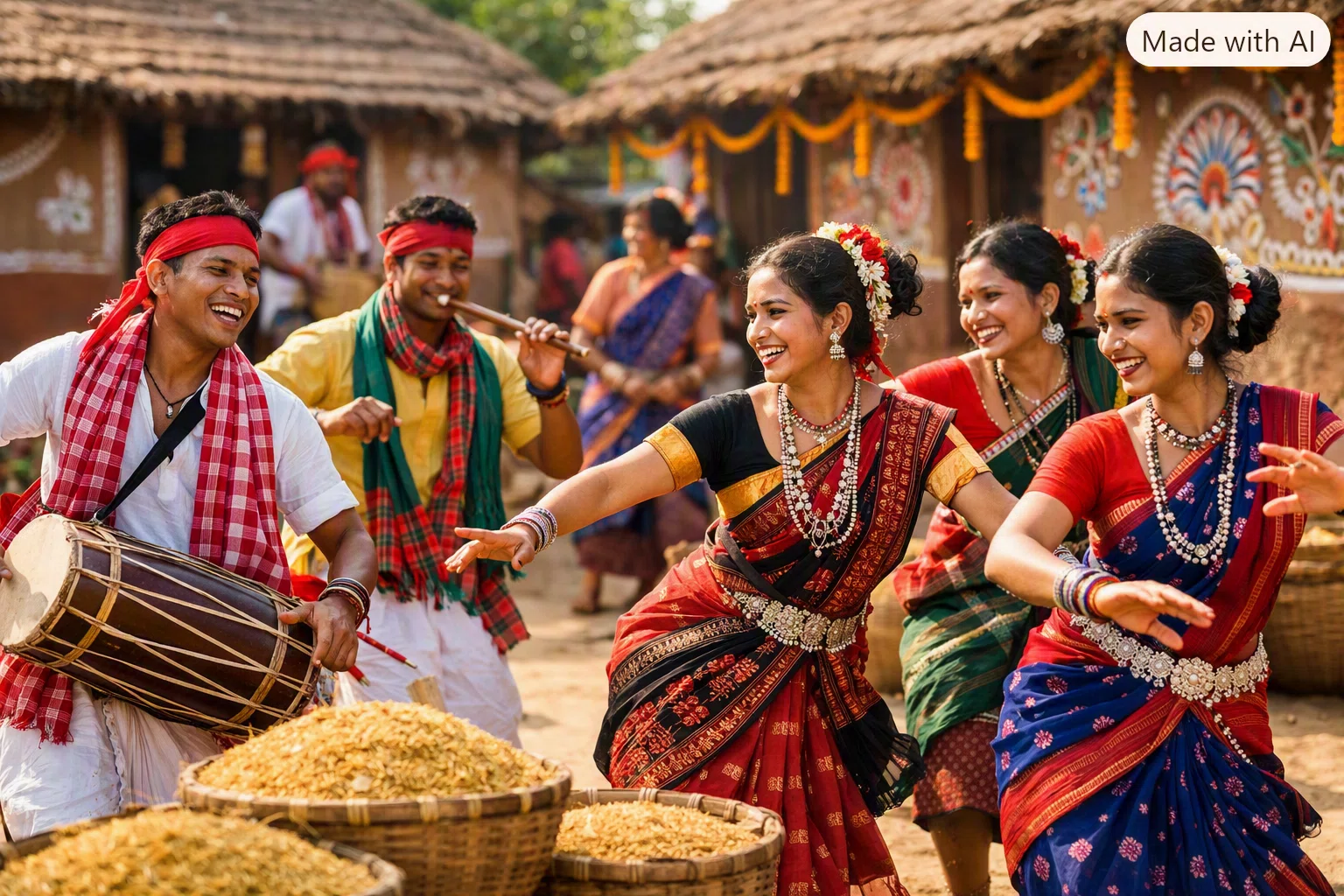
Once the religious and familial obligations conclude, the atmosphere transforms into a vibrant showcase of indigenous culture. The days surrounding Nuakhai are marked by spectacular displays of folk music and dance.
Artistes gather in village courtyards and public squares to perform the rhythmic Rasarkeli, Dalkhai, Malkhal, and Sanchra dances. Accompanied by the thunderous beats of traditional instruments like the Dhol, Nishan, and Tasha, these artistic expressions capture the joy, romance, and spirited ethos of the region. Traditional delicacies, including Pitha (rice-based pancakes) and sweets made from the new harvest, are prepared in abundance and shared freely across households, reinforcing the spirit of hospitality that defines Odisha’s cultural landscape.
Conclusion: Preserving Heritage in a Modern Era
By celebrating sustainability, collective harmony, and agrarian gratitude, the Nuakhai festival of Odisha remains a timeless monument to human resilience and community spirit. It ensures that as the state marches forward into modernity, its cultural soul remains forever anchored in the values of sharing, gratitude, and togetherness.