

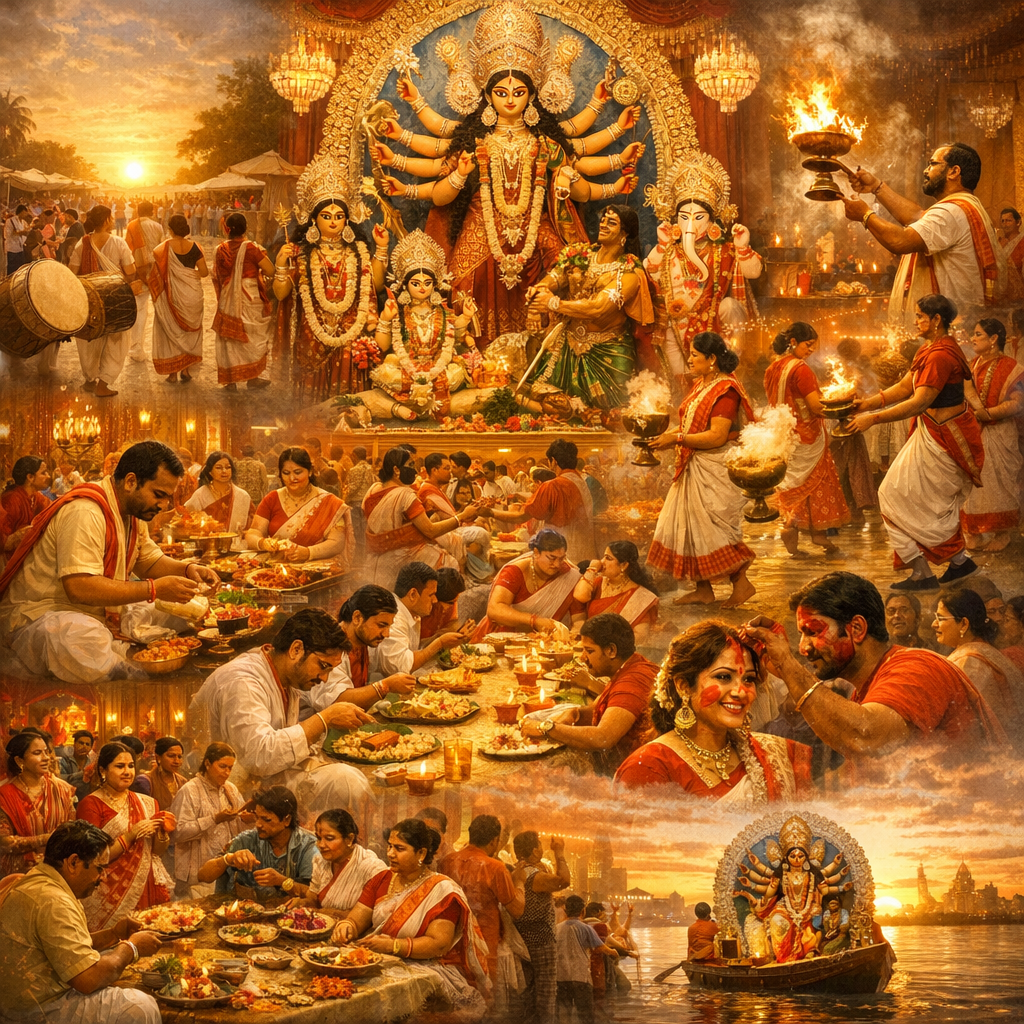
A Day-by-Day Guide from Shashthi to Dashami
Introduction to the Grand Finale of Durga Puja
While the worship of Goddess Durga spans the entire lunar cycle of Navratri, the true emotional, cultural, and spiritual peak of the festival unfolds over five extraordinary days—from Shashthi to Dashami. Known globally as Durga Puja, this grand celebration transforms streets, neighborhoods, and community pandals into vibrant hubs of artistic brilliance, devotional fervor, and massive social gatherings. Particularly prominent across Eastern India—including West Bengal, Odisha, Assam, and Tripura—these peak days represent the triumphant return of Goddess Durga to her earthly maternal home alongside her four children: Lakshmi, Saraswati, Kartik, and Ganesha.
Maha Shashthi: The Awakening and Welcoming (Bodhan)
The grand celebrations officially commence on Maha Shashthi, the sixth day of the lunar fortnight. On this day, the ritual of Bodhan is performed, which signifies the ceremonial awakening of the Goddess. According to mythology, Lord Rama woke the Goddess prematurely to seek her blessings before battling Ravana, establishing the autumn tradition of Akal Bodhan.
Pandal Hopping Begins: As evening falls, the intricate eyes of the clay idols are painted in a sacred ritual called Chakkhu Daan, and the pandal doors are officially flung open to the public.
Festive Ambience: Crowds begin to gather to witness the breathtaking artistry of thematic pandals, illuminated streets, and the rhythmic beat of traditional drums known as the Dhaak.
Maha Saptami: Navapatrika Pujan and the Dawn of Festivities
Maha Saptami, the seventh day, begins in the pre-dawn hours with an ancient ritual called Navapatrika Pujan (often colloquially referred to as Kola Bou Snan).
The Nine Plants: Nine different plant leaves and twigs—representing forms of Goddess Durga—are bathed in a holy river, draped in a traditional red-bordered white sari, and placed beside the main idol.
Spiritual Significance: This ritual highlights the deep-rooted ecological harmony of the festival, honoring nature and agricultural fertility as direct manifestations of divine feminine energy. Throughout the day, thousands queue up to offer their initial prayers (Pushpanjali) amidst the fragrant smoke of camphor and incense.
Maha Ashtami: The Core Spiritual Apex and Kumari Pujan
Maha Ashtami is widely regarded as the most spiritually intense and auspicious day of Durga Puja.
Kumari Pujan: In the morning, Kumari Pujan takes place across prominent temples and household pandals. Young pre-pubescent girls who have not yet attained puberty are worshiped as living embodiments of the Divine Mother, seated on elevated platforms and honored with ritualistic offerings.
Sandhi Puja: The emotional and cosmic climax of the festival occurs during the Sandhi Kaal—the exact transitional 48 minutes where Ashtami ends and Navami begins. This is believed to be the fierce moment when Goddess Durga transformed into Chamunda to slay the demons Chanda and Munda. Devotees light 108 earthen lamps, chant hymns, and offer intense prayers during this highly charged spiritual window.
Maha Navami: Sacrificial Offerings and Cultural Extravaganza
On Maha Navami, the atmosphere shifts into a high-energy celebration of art, food, and community bonding before the impending farewell.
Homa and Offerings: Special fire rituals (Homa) are performed to conclude the formal worship, accompanied by grand community feasts (Bhog) served to visitors regardless of caste, creed, or background.
Cultural Programs: Evenings on Navami feature spectacular displays of classical dance, music recitals, theatre, and massive crowds moving from one artistic pandal to another, marveling at the engineering and creative brilliance of modern temporary architecture.
Vijayadashami: Sindoor Khela and the Emotional Farewell
The final day, Vijayadashami, brings a bittersweet mix of euphoric celebration and profound melancholy. The day signifies the ultimate victory of good over evil (Vijaya).
Sindoor Khela: Married women gather inside the pandals to participate in Sindoor Khela, applying vermilion to the feet and forehead of the Goddess before playfully smearing it on each other. This ritual prays for long, prosperous marital lives and the enduring power of sisterhood.
Visarjan (Immersion): By late afternoon, the idols are taken out in grand, emotional processions accompanied by energetic Dhaak beats and dancing crowds to nearby rivers or water bodies for Visarjan—the immersion ceremony. As the clay dissolves back into the water, devotees bid a tearful farewell (Asche bochor abar hobe—“Until next year”), concluding the peak celebrations with the promise of the Goddess's return.